Enquiry Now


 Contact Us



 Check Out
 +44 20 4571 2395

 PRINCE2® Foundation and Practitioner Training



 Andy Trainer
 14 Mar 2011
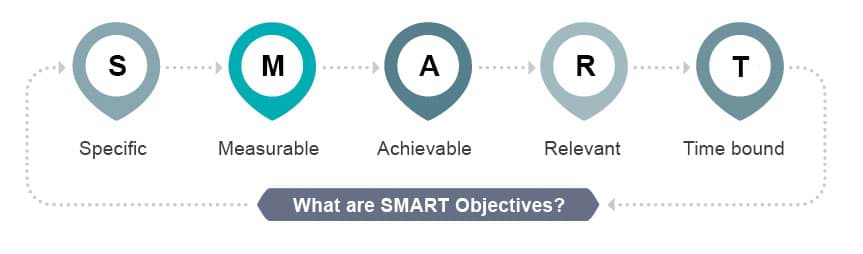
What are SMART Objectives?
Here at Silicon Beach Training we offer a wide range of Management Training & Leadership Training courses, and a topic that regularly appears in a lot of them is SMART objectives. So what are SMART objectives? In this post we take a look at how you can use them effectively.

Some of the training courses that look at SMART objectives in more detail include Management Skills for New Managers, Leadership Skills Training, Performance Management Training & Appraisals Training.
Goals, aims and objectives are often confused. All describe things that you want to achieve, however I see goals and aims as broader, more aspirational intentions whereas an objective is a narrower more defined task you need to achieve in order to meet your long term goals and aims.
All managers and leaders must be able to set effective objectives for their staff, whether they are to achieve project or task objectives, personal development objectives for people to grow in their role or performance standard objectives aligned with a competency framework, values or behavioural guidelines.
When setting objectives for your team you will need to ask yourself:
- What are my team’s targets and goals for the coming period?
- What standards do I need the team to maintain / improve?
Setting SMART Objectives
SMART is an acronym for the five characteristics used for setting effective objectives, they must be:
S: Specific
Objectives relate to a desired state of affairs in the future, and it is important that this desired state of affairs can be defined reasonably precisely. So the first quality of good objectives is that they should be Specific in describing what has to be done.
M: Measurable
The value in having a standard is that the individual, the manager and the organisation can see how well the standard is being achieved by monitoring progress. So an objective should be Measurable and its achievement should be reasonably verifiable by a third party. This does not eliminate the use of some subjective methods of assessment.
A: Achievable
Another quality of a good objective is that it is Achievable. Meeting objectives should bring about a positive benefit in personal development and job satisfaction, the way jobs are done or in the standards of performance achieved. For an objective to be achievable it must be realistic given the skills of the individual, the resources available and so on. So an objective should be stretching for an individual; too difficult an objective may create adverse effects and too easy an objective is unlikely to increase job satisfaction or be of benefit to the organisation.
R: Relevant
For an objective to be effective it must also be Relevant to the goals of the team, project, department and organisation and add value within this context. Some people use 'Realistic' here however we feel that this is covered under Achievable.
T: Time Bound
Any objective must have a deadline by when it is to be achieved. How else can an individual and/or the manager agree that the task has been achieved? So, an objective must be Time Bound. Communication is fundamental to the success of objective setting. There must be a constant review of what is possible, especially with conflicting demands on resources and changing priorities.
Posted under:
 Need Any Help?
Recent Blogs